Machine Learning for PURSUE 2026
Overview
This is the Machine Learning course web page for US CMS PURSUE workshop 2026. These particular notes are built upon the Machine Learning course web page for the US CMS PURSUE workshop 2025 and A minicourse in Machine Learning for Physicist. Given our modern day use of all things electronic, you can run, you can hide but you cannot escape ML. From smart phones to smart toothpastes, ML is everywhere. The aim of these development is to help physicists to wrap their head around all things ML.
In this course, “we’re here for a good time, not a long time” so let’s first learn what this course in NOT for
We are not going to learn facial recognition.
Not going to develop a algorithm that predicts our mood better than Youtube or Netflix.
No self-driving cars here.
Not even making AI driven music or art.
Nor would we learn to beat Magnus Carlsen in chess.
and million more things, that we are not going to learn.
The main objective of this course are
To introduce you to the basics of Machine learning with examples.
To develop a sense of statistics/data science algorithms that goes under the hood of a ML model.
Explain the terminology of machine learning.
Introducing you to some Python frameworks to start building your first Machine.
Getting familiarize with basic ML models that are although very common but can serve as a basic starting point.
Getting you prepared to learn on your own once this course is over.
With all these let us first have some basic motivation for learning ML in the context of our pursuit of artificial intelligence.
Aritificial Intelligence and Machine Learning
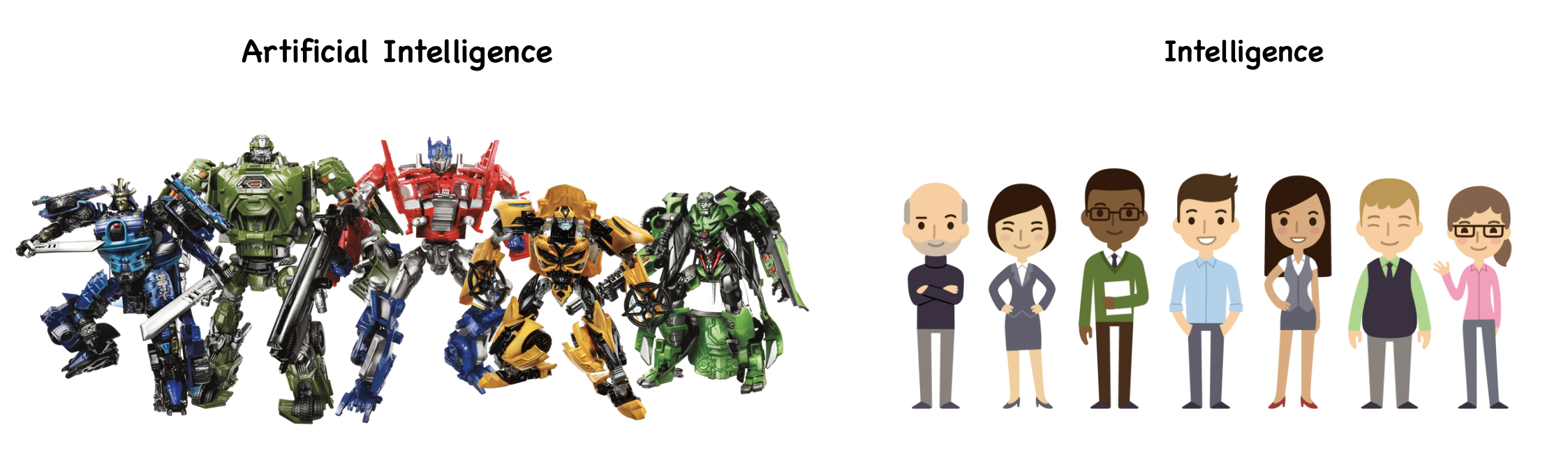
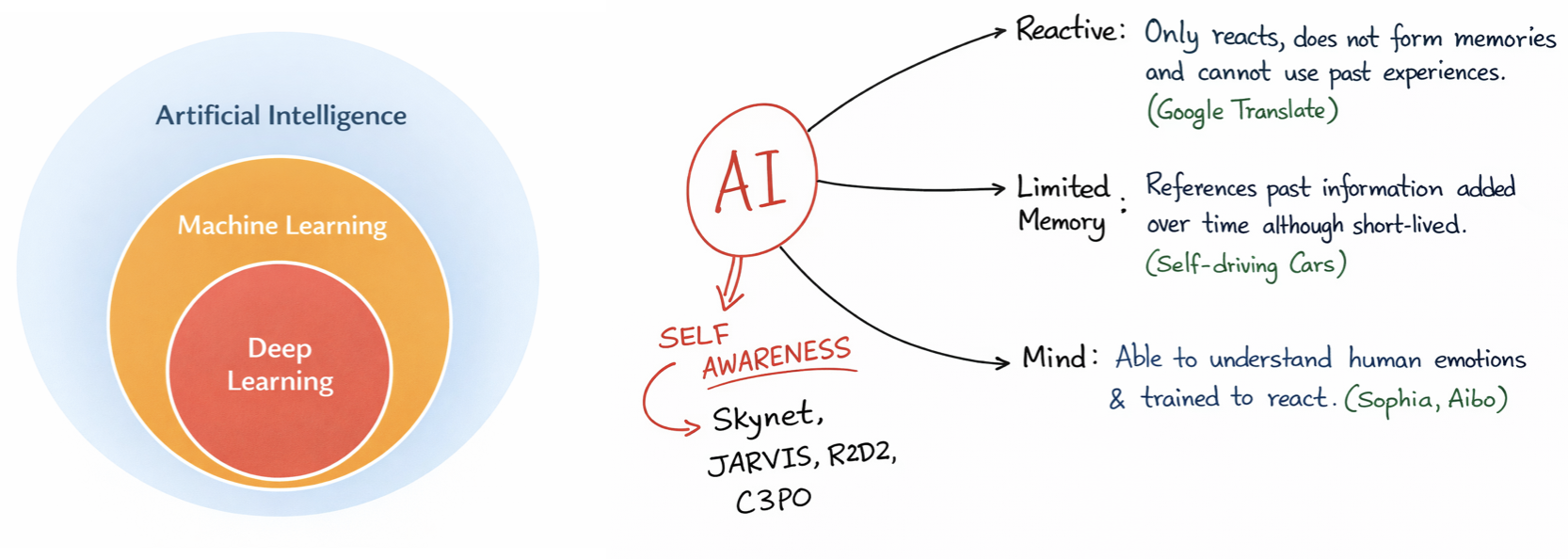
Aritificial intelligence leverages computers and machines to mimic the problem solving and decision making capabilities of the human mind.
Machine Learning
Machine learning is more dependent on human intervention to learn. Human experts determines the hierarchy of features to understand the difference between data inputs, usually requiring more structured data to learn.
Deep learning in general does not require that much structuring of data and extract features without much of a human intervention.
In classical programming, we the developers need to understand the aspect of the problem we are trying to solve, and to know exactly what all the rules are to make it to the solution
Example: Distinguish Squares and Circles
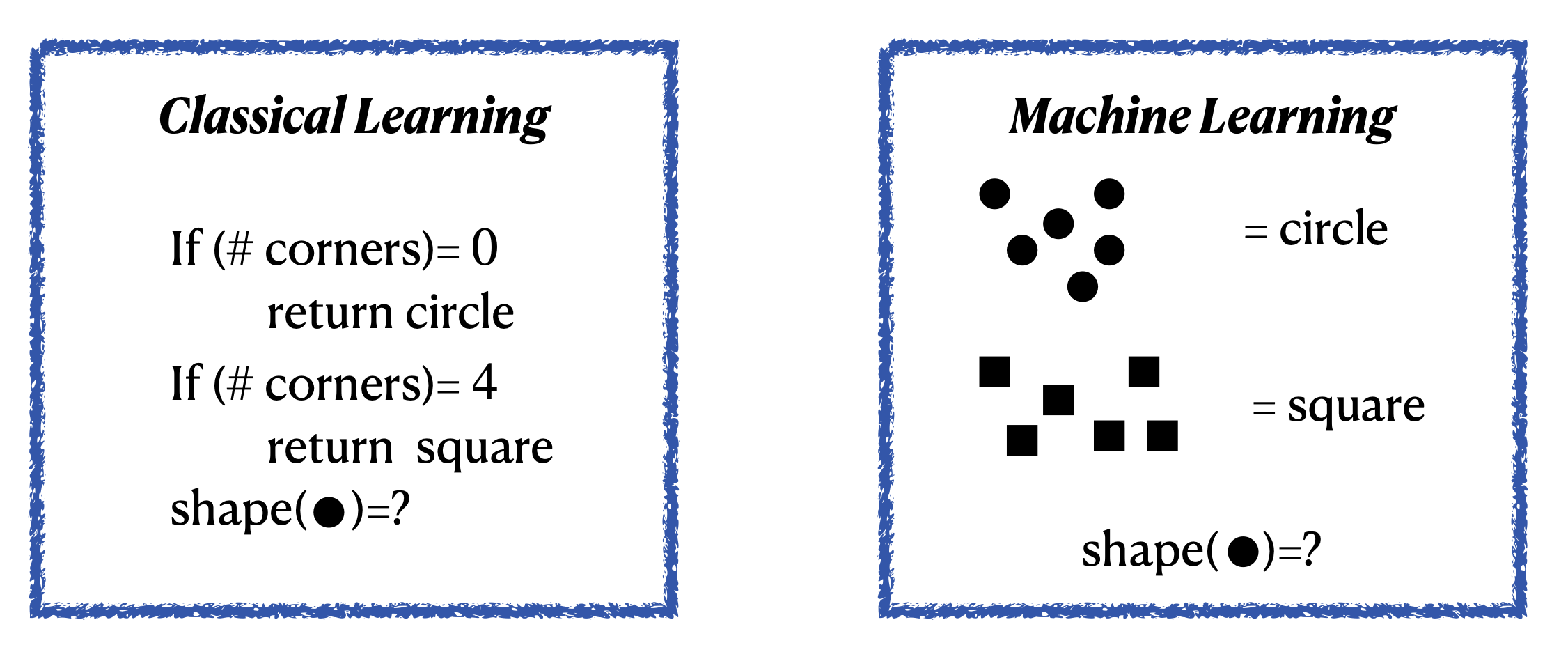
The standard coding algorithms that we use are constrained by statements like if, do-while, for etc. Even a very intelligent coder can only cover a finite number of scenarios through these.
Example: Self driving cars

What if: There is a human on a wet road and the signal in green??
Since our real world has infinite possibilities, explicit codings are not faithful or even practical .
Summary of machine learning
In a lot of sense ML can be summarised as the following
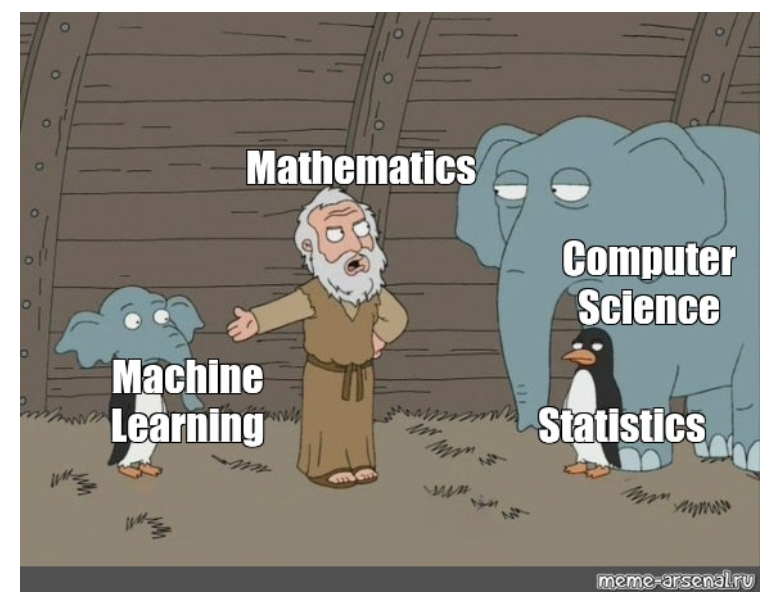
Figure 3:“Image source: https://
Rules for this minicourse
Each of the following chapter will have a
 button. Clikcing on the button will open up the Jupyter Notebook in Google Collab, where you can modify and run the files as you wish. Remember that the only way to learn is to start first.
There are questions in the jupyter lab notebooks, where the answers are hidden. But a single click would unveil the answers. The minicourse will work on an honour-system, you are not allowed to open the answers before you are told to do so.
For convenience, some of the code blocks are interactive. Since this website is a static page, a few of those interactive elements may look sleepy here and may not fully wake up on their own. But the moment you open the notebook in Google Colab or on your local machine and give it the magical boost of a live
Pythonkernel, they will spring into action.If some of the code cells do not run in Google Colab, check the warning or error message for missing packages and install them in a new cell using
!pip install <missing-package-name>
before running the notebook again.There are some errors intensionally made in the code, in case you find it, fix the bug on your own.